

|
Getting your Trinity Audio player ready...
|
Chelsea Football Club has confirmed the appointment of Xabi Alonso as their new manager, signing the Spanish football icon to a four-year contract starting July 1, 2026.
The announcement signals a fresh chapter for the Blues, who have endured a turbulent period both on and off the pitch.
Alonso, a former midfield maestro at Liverpool, Real Madrid, and Bayern Munich, is expected to bring a disciplined yet fluid approach to Stamford Bridge — aiming to restore the club to the upper echelons of European football.
In tthis article, FootballOrbit looks at his past managerial stints, style of play and team set up and what to expect from him at Stamford Bridge
From Midfield Maestro to Managerial Prospect
Alonso’s career as a player is widely celebrated, with a reputation built on vision, precision, and tactical intelligence.
His transition into management has been equally intriguing. He first made waves at Bayer Leverkusen, guiding the German side to an unbeaten league and cup double in the 2023/24 season.
Under his stewardship, Leverkusen showcased a style that combined tactical discipline with fluid ball movement, reflecting Alonso’s own philosophy as a player: controlling tempo, dominating possession, and emphasizing intelligent positional play.
However, his spell at Real Madrid was less successful. Despite the prestige of managing one of Europe’s elite clubs, Alonso struggled to instill consistency, cohesion and discipline in a squad full of individual talents.
His stint at Real further emphasised the growing influence of player power in modern football.
He lasted only seven months before departing in January 2026, leaving a lingering question about how his tactical approach would fare under intense scrutiny and pressure.
What to Expect from Xabi Alonso at Chelsea
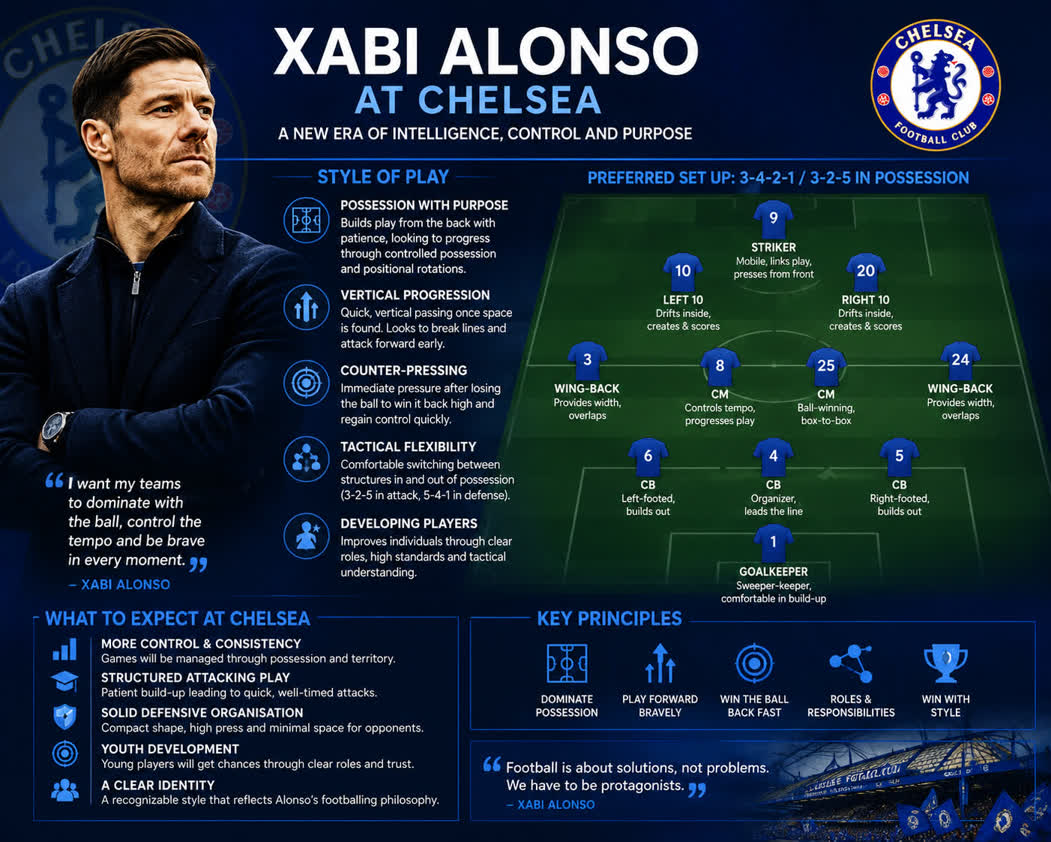
Chelsea arrives at the summer of 2026 in a period of transition. The team finished ninth in the Premier League and suffered a loss to Manchester City in the FA Cup final — underlining the need for tactical stability and effective leadership.
Alonso’s appointment comes with the title of “manager“, rather than “head coach“, granting him a broader remit over player recruitment, squad development, and long-term club strategy.
The Spaniard is expected to implement a style rooted in possession-based football, emphasizing control in the midfield, intelligent pressing, and patient buildup play. His philosophy revolves around:
- Positional Control: Using midfield squares and pivots to dominate central areas and bypass opposition presses.
- Adaptive Pressing: Trigger-based, coordinated pressing rather than frantic team-wide chasing.
- Fluid Formations: While a 3-4-2-1 formation is likely, Alonso is comfortable morphing into a 4-3-3 or fluid back-four structure when needed.
- Width and Overloads: Full-backs or wing-backs provide attacking width, creating overloads in both flanks and central channels.
Chelsea’s roster contains considerable young talent but lacks the cohesion seen at other elite clubs. Alonso will need to balance nurturing emerging stars with maximizing the output of seasoned professionals.
Likely Tactical Setup and Key Players
The 44-year-old is expected to favor a 3-4-2-1 formation, combining defensive solidity with fluid attacking movement.
Alonso’s in-game strategy emphasizes patient build-up from the back, positional overloads, and structured pressing to regain possession high up the pitch.
Therefore, Chelsea will aim to control matches, dictate tempo, and create high-quality chances through intelligent positional play rather than relying on individual brilliance.
The Challenges Ahead
While Alonso’s appointment is widely celebrated, he faces a daunting task. Chelsea have experienced managerial instability, with six permanent managers over the past four years — including Thomas Tuchel, Graham Potter, Mauricio Pochettino, Enzo Maresca, and Liam Rosenior.
The squad has also been criticized for a lack of cohesion despite significant investment, raising expectations that Alonso must deliver both structure and immediate results.
Additionally, the Premier League is notorious for its intensity and unpredictability. Alonso will be competing not only with Manchester City, Arsenal, Liverpool and Manchester United, but also with emerging challengers such as Newcastle United and Aston Villa — making the margin for error slim.
Early months at Stamford Bridge will be critical in winning over both fans and players, and establishing authority in a squad with diverse talents.
Future Prospects
If Xabi Alonso successfully adapts his managerial style to the Premier League, Chelsea could experience a revitalization.
His track record at Leverkusen demonstrates an ability to instill discipline and tactical intelligence quickly, while his experience at Real Madrid provides lessons on managing star-studded squads under pressure.
Over time, Alonso has the potential to stabilize Chelsea, implement a coherent footballing philosophy, and restore the club’s presence in both domestic and European competitions.
Furthermore, Alonso’s vision for club culture and development suggests that Chelsea could benefit from a stronger internal structure, with youth development and squad cohesion becoming central pillars of the team’s identity.
Fans could witness not only success on the pitch but also a recognizable, strategic, and attractive style of football.
Conclusion
Xabi Alonso’s arrival at Stamford Bridge represents more than just a managerial change; it signals a calculated gamble for Chelsea.
The club has entrusted a coach with a clear footballing identity, proven early success, and a reputation for intelligent leadership.
Thus, the coming months will test Alonso’s ability to translate his philosophy into results, balance youth and experience, and navigate one of the most challenging leagues in the world.
For Chelsea supporters, the appointment offers cautious optimism — a chance to witness a new era defined by strategic sophistication, cultural rebuild, and the possibility of lifting silverware once more.
If Alonso succeeds, Stamford Bridge could once again become a fortress of both domestic and European success, heralding a period of stability that has long eluded the Blues.